
How smooth airflow movement strengthens daily production workflow
A production line becomes efficient only when materials travel from one point to the next without delays or inconsistencies. When powders and granules move cleanly and continuously, machines run at full performance and workers spend less time managing blockages or manual feeding. A well engineered pneumatic conveying setup supports this by using controlled airflow to transfer bulk materials with reliability and speed. Instead of relying on mechanical belts or manual loading, pneumatic conveying creates a streamlined path where air pushes material through pipelines to the required locations. Industries choose this approach to reduce manpower demands, improve hygiene, and maintain long running performance without frequent interruptions. Many businesses now depend on Rajath Material Handling Systems Pvt Ltd because they design systems that move powders and granules efficiently while protecting product quality.
Bulk material handling becomes easier when airflow takes responsibility for movement rather than physical contact. With minimal moving parts, the system experiences less wear and tear. This leads to lower maintenance cost and better uptime throughout the year. When pneumatic conveying is implemented correctly, plants operate with improved stability, reduced dust release, and better workflow accuracy.
Why industries prefer controlled movement over manual transfer
Manual transfer requires time, physical effort, and constant attention. Workers carry bags, pour materials into machines, and adjust feeding levels repeatedly. This process creates fatigue and introduces inconsistency. A structured pneumatic conveying line replaces manual lifting with automated feeding. Material enters pipelines through valves or feeders and travels smoothly to silos, hoppers, mixers, or packaging units. The system maintains speed and volume based on plant requirement. Operators simply monitor instead of performing repeated physical work, which increases productivity quickly.
Rajath Material Handling Systems Pvt Ltd builds systems that reduce labor dependency and support long shift operations. This ensures that product movement stays consistent even when staffing changes or demand increases.
How pneumatic conveying reduces product waste and dust escape
Powders are vulnerable to spillage when handled openly. Traditional material transfer exposes them to air, creating dust clouds and product loss. A properly sealed pneumatic conveying system prevents this by enclosing the entire flow. Material remains inside the pipeline from source to destination. Dust does not escape, product does not spill, and the workplace stays clean. For industries like food, pharmaceuticals, and chemicals, this control is crucial for hygiene and safety.
Systems from Rajath Material Handling Systems Pvt Ltd include dust controlled feed points and filtration support. This ensures that plant air remains clean, employees work comfortably, and material quality remains pure even during long runs.
Better energy use through low friction transfer
Mechanical conveying often involves rollers, belts, and moving equipment that consume more power because of friction. Pneumatic conveying relies on airflow instead of direct surface contact. Lower friction means lower energy requirement. The system pushes material with controlled air pressure, which helps maintain a smooth transfer path without heavy mechanical parts.
By selecting correct blower capacity and optimized pipeline length, Rajath Material Handling Systems Pvt Ltd ensures that the system runs with balanced energy consumption. This results in reduced operational cost and longer equipment life.
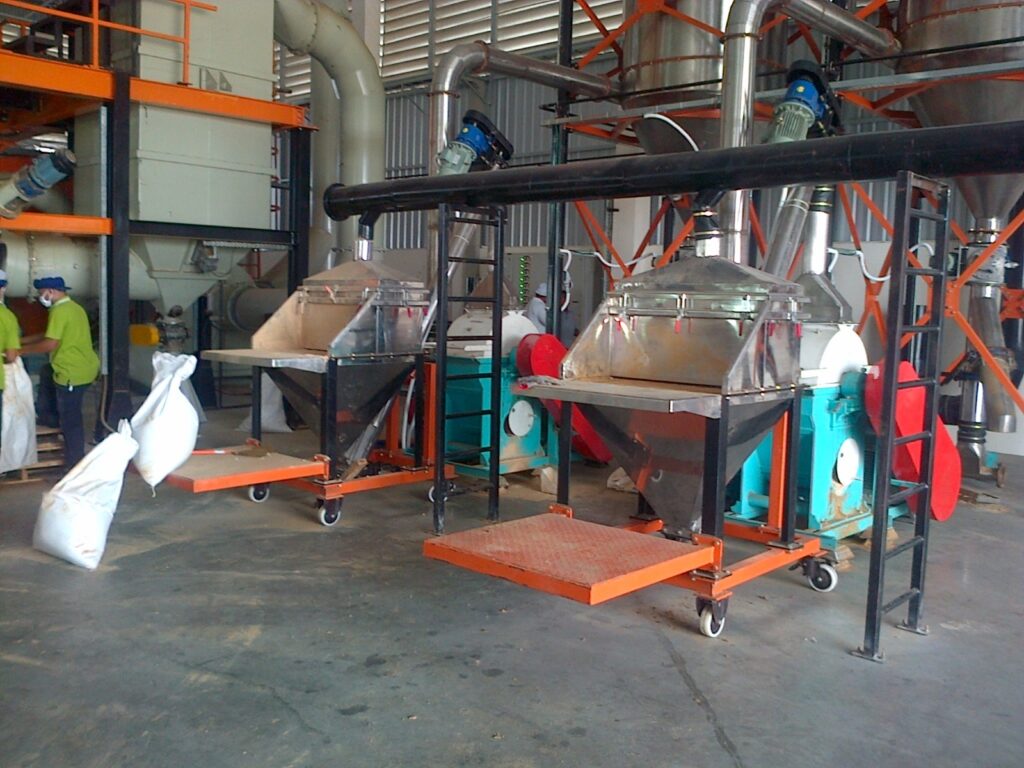
Consistent flow creates better batch accuracy
Production quality depends on uniform feeding. If powders reach mixers and hoppers unevenly, the batch composition changes. Some areas receive too much material while others receive too little. A stable pneumatic conveying line maintains continuous feeding without choking or sudden surges. This improves accuracy in blending, extrusion, molding, and packaging applications.
Rajath Material Handling Systems Pvt Ltd designs systems where flow rate remains predictable even at high demand. This gives plants better control over recipe accuracy and end product consistency.
Flexible routing helps plants expand with ease
Conventional mechanical conveyors need space, alignment, and constant access. Pneumatic conveying pipelines can route overhead, across long distances, and around corners without structural reconstruction. This flexibility helps industries expand easily when new machines or process lines are added.
With the support of Rajath Material Handling Systems Pvt Ltd, plants integrate new equipment without rebuilding entire layouts. The pipeline adjusts to changes with minimal downtime.
Lower maintenance keeps uptime high throughout the year
Less equipment contact means less wear. Since pneumatic conveying uses air pressure instead of mechanical force, belts, bearings, and chains are not required. This reduces unexpected shutdowns and repair expenses. Maintenance becomes simple because there are fewer components to inspect, lubricate, or replace.
Systems implemented by Rajath Material Handling Systems Pvt Ltd run for long durations without frequent servicing. Plants benefit from uninterrupted production and better annual output.
How pneumatic conveying improves hygiene for sensitive products
Materials that absorb moisture or degrade when exposed to open air require controlled handling. Pneumatic conveying keeps these powders inside sealed lines, protecting them from contamination. This is especially valuable for food powders, pharmaceutical ingredients, and chemical compounds.
The enclosed design prevents contact with operators, equipment surfaces, or airborne particles. Rajath Material Handling Systems Pvt Ltd considers product sensitivity and system cleanliness during planning. This helps plants maintain quality certification and meet regulatory standards.
Why pneumatic conveying supports high efficiency in real industrial environments
Efficiency is not measured only by speed. It is measured by how consistently equipment performs, how much waste it prevents, and how reliably it supports workflow. A well built pneumatic conveying line delivers steady feeding, clean transfer, reduced load on workers, and lower machine damage. These benefits directly improve plant efficiency.
With Rajath Material Handling Systems Pvt Ltd, industries gain conveying systems that integrate well with packaging machines, mixers, dryers, extruders, and silos. This creates a unified handling process that wastes less time and material.
A high efficiency conveying approach that strengthens every part of production
Pneumatic movement gives plants the ability to transfer large volumes of powder and granules with minimal waste, low energy demand, and consistent flow. With support from Rajath Material Handling Systems Pvt Ltd, industries receive reliable equipment that improves workflow, reduces dust, maintains batch stability, and cuts operational cost. A high efficiency system is one that works quietly in the background while production grows smoothly every day. Pneumatic conveying delivers exactly that level of performance.